Blog


Composting Toilet for RVs: The Complete Guide to Going Waterless on the Road

The RV Toilet Dilemma

Separett Tiny

Thinktank toilet in 5th Wheel

Thinktank toilet in 5th Wheel

If you’ve spent any time RVing or living the van life, you know the black tank is the least glamorous part of the journey. Frequent dump station runs, odor issues, and limited holding capacity can turn a great trip into a hassle.

That’s why more RVers are switching to a composting toilet or urine diverting waterless toilet for RV use — a system that eliminates black tanks entirely and lets you camp longer off-grid, without the smell or hassle of black water tanks.

This guide covers how RV composting toilets and RV waterless toilets work, why they make sense for RVs, and what to look for before buying.
What Is an RV Composting Toilet?

The key to toilet success is urine separation. Liquid waste (urine) combined with feces creates that awful sewagae smell, and this is the main source of odor in traditional RV toilets with holding tanks. Diverting the urine reduces this odor drastically.

Solid waste alone takes up much less space. A high capacity waterless or composting toilets needs emptying infrequently.

Why RVers Are Switching

  1. No more black tank.
  2. No sensor issues.
  3. No chemical treatments.
  4. No smell.
  5. No constant search for a dump station.
  6. Longer off-grid stays. The liquids container is the only part needing frequent emptying, so
    RVers can stay boondocked far longer without worrying about tank capacity.
  7. Huge water savings. Traditional toilets use fresh water with every flush, draining your tank fast
    when dry camping. A composting toilet uses little to no water.
  8. Less weight, simpler plumbing. Removing the black tank reduces weight and complexity
    — valuable in vans, teardrop trailers, and skoolies where space and payload matter.
  9. Better for small or converted vehicles. Full size models like the Thinktank Waterless Composting Toilet are ideal for larger RVs, Airstreams, trailers or bus conversions. Smaller self-contained units like the Separett Tiny 1270 are purpose-built for smaller RVs and van conversions where space is a premium, or a black tank won’t fit.

Thinktank toilet in Airstream

What to Look For When Choosing One

  • Size and footprint — measure your bathroom space carefully. Check the seat height – it should be in the 17″ to 20″ range for most people.
  • Liquid tank capacity — larger tanks mean fewer stops, ideal for full-time travelers.
  • Ventilation — this is absolutely critical. The better toilets use a quiet fan (usually about 1 watt) to vent odor and moisture outside, keeping the cabin smelling fresh. Without  fan, you are burying the waste under sawdust or another organic medium, and hoping it doesn’t stink.Many of the less expensive composting toilets do not have fans or external vents of any kind. This is, in our opinion, a terrible design. Builders like them because they are easy to install. Owners like them (at first) because they are small and cute. But they will eventually stink. There is stinky air in there, and it will – sooner or later – escape. Vast experience has proven this to us. Nothing spoils a good dinner faster than a whiff from your toilet, hidden in a sliding drawer beside the kitchen. Get a toilet with a fan and a vent!

    NOTE: Plan the venting so the exhaust is far from any area where people might gather. The roof is ideal. Through the floor is another good option.

  • Ease of emptying — removable, lightweight solids bins and simple liquid containers.
  • View screen. A view screen hides the toilet contents when not going number 2. Without a few screen, whenever you open the toipet to pee, you are staring at the sold waste. We find it astonishing  that many RV composting and waterless toilets are available without view screens.
  • Build quality — look for durable, well-sealed construction for a moving vehicle. Stainless steel metal hardware is a bonus.
  • Large bowl or chute. A larger chute (preferably with vertical sides) means FAR less clean up. Many toilets have small openings. A mess will result every time – which then must be cleaned up.

Maintaining a Composting Toilet in an RV

roof vents

Holes drilled and ready to install air intake and exhaust

This varies depending on the tye of toilet you have. Urine diverting waterless toilets that contain the waste in a compostable bag are easiest. Just remove the bag and dispose of where appropriate.

Some RV composting toilets require a much more complex procedure. You must remove the top section and set it aside. Then release the base from the floor, normally with two thumb screws, then take the base outside, and dump the contents in a bag or bin for further composting. Reattach the base to the floor, prepare and hydrate coco coir, place the hydrated coco coir in the toilet, and put the top section back on.

You can see that the bag method is much easier.

Other than that, it is easy:

  1. Empty the liquids container every 1–3 days depending on tank size and usage.
  2. Run the fan whenever the RV is occupied to manage moisture and odor.
  3. Clean all surfaces components periodically with a mild, liquid cleaner. Never use a cream cleaner or abrasive cleaner. Treat it like an acrylic shower stall. Gel Gloss is one brand that works well.

Is a Composting Toilet or Waterless Toilet Right for Your RV?

If you rarely boondock and always have hookups, a traditional toilet may still be simpler. But for off-grid freedom, easier maintenance, or fitting a smaller conversion vehicle, a composting toilet solves real, everyday problems — and today’s models are far more compact and low-odor than older designs.

Final Thoughts

Switching to a composting toilet or waterless toilet can be one of the most impactful upgrades for off-grid comfort. It cuts maintenance, saves water, extends time without hookups, and removes the RV’s most unpleasant chore — the black tank.

Ready to make the switch? Composting Toilets USA is the exclusive distributor of the Thinktank Waterless Toilet and an official Separett dealer, offering tested, RV-ready waterless toilets with real one-on-one customer support. Shop composting toilets for your RV today or call 1-877-783-0681 to talk to a real person (Not AI) about the right fit for your rig.


Off Grid Toilets: Everything You Need to Know Before You Buy

Off Grid Sanitation

Composting Toilet in Yurt

Off Grid Toilet in a Yurt

Moving off the grid means rethinking the systems most people take for granted, and nothing
gets overlooked more often than the bathroom. Solar panels and water tanks get all the
attention, but the question that really determines your comfort is a simple one: what happens
when nature calls? The answer, for a growing number of cabin owners, tiny home dwellers,
van lifers, and homesteaders, is an off grid toilet that needs no plumbing, no septic tank, and
no water at all.

Why Traditional Toilets Fail Off the Grid

A conventional flush toilet is one of the most wasteful fixtures ever invented. Americans flush
away roughly 123 billion gallons of clean water every year, and every flush turns drinking-quality water into toxic sewage that must be treated. Off the grid, that model collapses entirely.

Septic systems are expensive to install, require soil testing and permits, and are often impractical on rocky, remote, or environmentally sensitive land. Hauling water just to flush it away makes even less sense when every gallon counts.

An off grid toilet solves all of these problems at once. It requires no water hookup, no drain field, and no connection to municipal sewage. Done right, it is also completely odor free.

The Best Off Grid Toilet Is a Urine-Diverting Waterless Toilet

Not all off grid toilets are created equal. Bucket toilets are cheap, but stinky and unpleasant. Incinerating toilets consume enormous amounts of propane or electricity. The burners eventually fail, and they are expensive to replace. Finally, the exhaust can be an odor problem.

Old-style “true” composting toilets attempt to compost waste inside the unit itself, which sounds great in theory but does not always work in practice — the waste simply doesn’t have enough time to fully break down, excess urine may not evaporate, and the waste may still be a health risk when removed – necessitating further composting in a bin outside.

Large capacity waterless toilet

Large capacity waterless toilet

The breakthrough is urine diversion

When urine and solid waste are combined, they create the classic sewage smell everyone dreads. Separate them, and the odor problem is drastically reduced.  In a urine-diverting waterless toilet, liquid is directed to a gray water system, small gravel pit, or French drain, where it percolates away harmlessly. Solid waste is collected in a compostable bag inside the toilet, allowing weeks of use between emptying.

A quiet built-in fan runs continuously, pulling air from the bathroom down through the toilet and venting it outside.

What to Look For in an Off Grid Toilet

Size and features genuinely matter. Many small units on the market have tiny solids containers under three gallons, which means emptying every few days. Look for a generous capacity that stretches to 50 or 60 uses between changes.

A view screen or trap door is essential too — nobody wants to stare at waste every time they lift the lid. And insist on a vented design with a fan; unvented toilets that rely on burying waste under sawdust inevitably develop odor problems.

For those who want the best of the best, the Thinktank Waterless Composting Toilet was engineered specifically to solve the common shortcomings of earlier designs. Developed over five years of enginnering and real-world refinement, it is 100% odor free, energy efficient, easy to empty, and pleasant to use — everything an off grid toilet should be.

What About the Solid Waste?

compare composting toilets

Make sure any toilet you are considering is not gross to empty. This toilet uses a compostable bag to contain the waste. Wood shavings are put down the hatch prior to emptying. Perfect!

The solid waste from a urine-diverting toilet can be composted outdoors in a drum or compost bin, eventually producing a safe, non-toxic material suitable for ornamental plants. You can read more details here – How to Compost Human Waste.

If composting isn’t an option, the bagged waste can typically be disposed of in the trash — it’s not much different from disposable diapers. Check with local authorities if in doubt.

Ready to Go Off Grid?

If you’re serious about off grid living, don’t settle for a smelly compromise. Composting Toilets USA is the exclusive worldwide distributor of the Thinktank Waterless Toilet™, and they only sell composting toilets — nothing else. Every purchase includes free shipping to the lower 48 states, a 30-day return policy with no restocking fees, and real one-on-one customer service from an actual person.

Have questions? Call toll free at 1-877-783-0681 and talk to a real expert who will make sure you get the right off grid toilet for your needs.


Composting Toilets for Tiny Homes: The Complete Guide

Living in a tiny home means making smart choices about every square foot — and no
decision matters more than your toilet. Traditional flush toilets need plumbing, a septic
connection or sewer hookup, and gallons of fresh water for every flush. That’s a dealbreaker
for most tiny homes, especially those built on wheels or placed on off-grid land. That’s
exactly why composting toilets for tiny homes have become the go-to solution for thousands
of tiny house owners across the country.

Why Composting Toilets Are Perfect for Tiny Homes

A composting toilet is completely waterless. There’s no flush tank, no black water tank, and
no plumbing hookup required. For tiny home owners, that translates into three big wins.
Freedom to park or build anywhere. Whether your tiny house sits on rural land, in a
backyard, or travels on a trailer, a composting toilet works without a sewer or septic system.

Many owners choose them specifically because installing a septic system can cost $10,000
or more. (I have heard of $25,000 installations).

There are massive water savings. Americans flush away roughly 123 billion gallons of clean water
every year. A standard toilet uses 1.6 gallons per flush — water most tiny homes simply
can’t spare, especially when relying on a small fresh water tank or rain catchment.

Composting Toilet for Tiny Home

The Thinktank toilet is perfect for Tiny Homes

No odor when done right. This surprises most people. A quality urine-diverting composting
toilet is virtually odor-free. By separating urine from solid waste, the source of that classic
sewage smell is eliminated.

A small, whisper-quiet fan (about 30 to 40 decibels) continuously
pulls air from the toilet out through a vent pipe. When the trap door is opened, it becomes a giant air intake. Stinky air never enters the bathroom – even when using the toilet. So your tiny bathroom actually smells fresher than one with a flush toilet.

How Composting Toilets for Tiny Homes Actually Work

Modern urine-diverting waterless toilets separate liquids and solids right at the bowl. Urine drains to a small tank, gray water system, or French drain, where it percolates away safely — urine is virtually sterile and poses no health risk. Solid waste drops into a container lined with a compostable bag, where it loses moisture and shrinks, allowing many uses between emptying.

Thinktank toilet in outhouse

Fancy Outhouse with Zero Odor

When the container is full, you simply remove the bag and add it to an outdoor compost bin
or composter. There’s no mess, no sludge, and no chemicals — just a simple, hygienic process that takes a few minutes.

What to Look for in a Tiny Home Composting Toilet

Not all composting toilets are created equal, and in a tiny home, the details really matter:

  1. Solid waste capacity. Some compact toilets have containers under 3 gallons, which means emptying every few days. Look for a larger capacity so you only empty every 50 to 60 uses.
  2. A view screen or trap door. Without one, you’re staring at waste every time you lift the lid. A quality toilet conceals the contents completely.
  3. A ventilation fan. Toilets without fans rely on burying waste under sawdust or another organic medium — and they still
    inevitably smell. A vented toilet with a fan is essential for a genuinely odor-free tiny home bathroom.
  4. Comfortable, full-size design. Many tiny toilets are little more than a seat on a box. You’ll use this every day — comfort counts.

Our Top Pick for Tiny Homes

Composting Toilets USA has sold and distributed many brands of composting and waterless toilets for over 15 years. We have learned what works, and what doesn’t. We decided to combine the best features of other waterless toilets, along with a few innovative ideas of our own – and the Thinktank was born. It took 5 years of design engineering, along with many prototypes that were extensively field tested in every climate.

Now 6 years later we are confident that the Thinktank Waterless Composting Toilet 
is the best toilet of its type available. It’s 100% odor-free, energy efficient, easy to empty, and features a generous solids capacity — ideal for full-time tiny home living.

And it’s built exceptionally well, with the best warranty in the industry.

Ready to go Waterless?

If you’re planning your tiny home bathroom, Composting Toilets USA is the place to start.
As the exclusive worldwide distributor of the Thinktank Waterless Toilet™, they only sell
composting toilets — which means real expertise, honest advice, and one-on-one customer
service from a real person. Every toilet ships free to the lower 48 states, backed by one of
the best return policies in the industry.

Call toll free at 1-888 361 0014 and talk to a real person, or browse the shop today to find
the perfect composting toilet for your tiny home.


Customer Installations

Here are pictures and videos from customers who have installed the Thinktank Waterless Toilet. Please send us yours!

Notice how the pipes can often be hidden behind the toilet – if venting straight out behind, though the wall. This makes for a clean, attractive installation.


Top 12 things to know before buying a composting toilet.

Top 12 things to know before buying a composting toilet 

Gain important knowledge, and avoid buying the wrong composting toilet. These 12 tips will help you avoid expensive mistakes.
Thinktank Waterless Toilet

The Thinktank has high capacity.

  1. Will it stink inside? Absolutely not, as long as you have a toilet with a vent and fan. The fan draws air into the toilet, and exhausts the stinky air outside. It should never enter the bathroom area.
  2. Will it stink outside? There can be a bit of odor where the vent terminates the home. This is less with a urine diverting toilet. The vent should not terminate near a deck, door, or opening window. If in doubt, run the vent up to the roof line. Do not believe anyone that tells you that you don’t need a vent. There is moist, stinky air in that toilet and it MUST go outside.
  3. Does it have a view screen or trap door?  Surprisingly, many toilets do not have a view screen or trap door to conceal the solid waste. That means that every time you open the lid, you are staring at the last user’s poop! Ugh. No. The better toilets all have concealing view screens or trap doors that hide the waste from the user until opened.
  4. Is it legal? Probably, but legality varies widely. Usually, permits can be obtained (if necessary) by approaching senior managers at the county office. Inspectors generally can’t approve them, because it’s not in the code book. You can read my detailed post on the subject here. Are Composting Toilets Legal?
  5. Is it a urine diverting design? The better toilets separate urine from solids. Urine is practically sterile, and very easy to dispose of safely. Solids begin drying out quickly, lose odor, and also become easy to dispose of. When you combine urine and feces in one tank, it becomes much more difficult. You might need powerful heaters.

    Adding some cover material before emptying the Thinktank toilet

    Add a scoop of wood shavings before emptying. There should be no odor at all.

  6. What do I do with the solid waste? You need to think about this carefully, because human waste can pollute the water and make people sick if not properly managed. Store the waste in a compost bin outside (I like the rotating bins). Ideally choose a bin that is sealed and cannot leach any liquid on to the ground (but is not airtight – there must be good ventilation). Ideally you will have 2 bins. Once the first bin is full (and that can take a year or more depending on the number of users), start using the second bin. When the second bin is full, the contents of the first bin can be placed on non edible plants.
  7. How will I vent it? Vent it through the wall or roof. Most of what you need should be supplied with the toilet for a basic installation. Extra pipe can be purchased locally if needed.
  8. How will I get rid of the urine? Urine can go into a gray water system (with the shower or sink water), or it can be drained into a rock pit, such as a French drain.
  9. How often will I empty it? For two people: the smaller composting toilets for vans and RVs need to be emptied frequently. Probably every week or even more often. The larger toilets like the Thinktank will be emptied about every 3-4 weeks . This varies with the amount of toilet paper that is used, and whether of not a cover material is added.
  10. Is there excellent service and support? Customer service and support is critical when buying a composting toilet. Make sure you can reach the appropriate people directly and easily. (This seems almost impossible these days). You will have questions. It’s best to buy from someone specializing in composting toilets, rather than a hardware store, or someone selling all kinds of products. You need expertise here. It’s critical to get the right toilet, and to install it properly.
  11. Can men stand when using? Many toilets require men to sit when urinating. Some men will not do this.
  12. Can insects get into the toilet? Most toilets are not tightly sealed, and it’s easy for small fruit flies to get inside, where they rapidly multiply. An airtight toilet is a better bet.

If you have other questions on composting toilets, please let me know.


How to Safely Compost Human Waste

How to Compost Human Waste

Fully Composted Human Waste

Composted Human Waste is excellent fertilizer for non-edible plants.

Disclaimer: These are my suggestions only, based on recommendations from the World Health Organization. I make no guarantees about the accuracy of this information, and whether or not it applies to your specific situation. If in doubt you should check with your local authorities.

This is an article on how to safely and easily compost human waste. It’s not difficult, but you MUST do it right, or people could get sick. The main issue is the solid waste – feces. It’s easy to deal with urine. More on urine below.

Solid human waste (feces) can be safely composted by carefully following a few simple guidelines.

First, it is much easier to compost human waste waste from a urine diverting composting toilet. The material removed from a urine diverting toilet should be just slightly damp – perfect for composting. With a non-urine diverting toilet, the contents will be too wet for efficient composting, and the combination of urine and feces creates an anaerobic environment that allows very stinky bacteria to flourish (think outhouse or portable toilet at large public event. Ugh!). A urine diverting toilet is key to the successful composting of human waste, in my opinion.

compost human waste

Composted Human Waste

When the human waste is removed from the toilet, you should place it in a dedicated composter. The type of container is very, very important! It must not leach out the bottom or sides, as this might contaminate groundwater. It must be protected from rain and snow – it cannot get wet. And it must have lots of ventilation.

Compost bin for human waste

Aerobin hot compost bin for human waste

Hot composting is a game changer.

Recently I have become a firm believer in “hot composting”. Rather than wait a year or longer for waste to compost in a typical compost bin, you can drastically speed up the process with hot composting – which is basically an insulated compost bin. I am now getting compost in about 8 weeks – sometimes even less. All visual traces of human waste and toilet paper are disappearing very quickly – often in just a few days. (This is in summer. In the winter it will be slower).

Many hot composters are pretty expensive, but I use the 55 gallon Aerobin from Costco, which is very affordable. It was a bit of work to assemble, but it is working great, and I recommend it. The 55 gallon bin is perfect for two or three people, full time. Bigger groups might consider the 111 gallon version. The Aerobin is not quite as sturdy or as well insulated as the more expensive bins, but at 1/3 of the price you can’t beat it.

You can also make a hot composting bin. Instructions are here.

Redmon Compost Tumbler

Redmon Compost Tumbler

You must add other material to the compost bin, such as sawdust, leaves, grass, table scraps etc. It is a good idea to learn a bit about composting basics online. You need about a mix of “greens” and “browns”.

I just toss in some kitchen scraps (nitrogen rich) and sawdust or shavings (carbon rich) about twice a week, and mix it all up with a small gardening fork (This aerates the material and helps it break down). I add human waste as we produce it – about once a month. Dig a little hole for the human waste inside the bin, and dump it (preferably without the compostable bag which can take a long time to break down), and cover with sawdust and kitchen scraps.

Adding some cover material before emptying the Thinktank toilet

Emptying the toilet is NOT gross!

Much has been written about the “correct” ratio, and no one seems to agree. I don’t think about it too much, and add roughly 50:50 greens to browns. Human waste can be considered neutral, and not a green or a brown.

Feed the beast!

If possible you should “feed” your compost bin with something once or twice a week. This keeps things going, and speeds up the composting process. At a minimum, you should definitely monitor the contents from time to time. If it seems wet (it should be just slightly damp), add dry grass, dry leaves, or some other dry carbon rich material. If it’s too dry, you’ll need to add a bit of water, and possibly more nitrogen rich material like green plants. It’s actually pretty simple and easy. Keeping the contents just slightly damp will ensure rapid and complete composting.

The beauty of the hot composting method is that you will be removing finished compost from the bottom of your container as fast as you can feed it in through the top. After the material is removed, some suggest storing it in a pile for several more months, to ensure it is fully broken down and safe for non-edible plants as fertilizer.

Redmon Compost Tumbler for Human waste

Compost Tumbler with large opening hatch

Additional Tips to Successfully Compost Human Waste

You might eventually need two compost bins to compost human waste, especially if you have a bigger family. In this case, use one at a time. When the first bin is full, start using the second bin. When the second bin is full, the first one should be ready for the plants.

There are bins with two chambers. This is intriguing, but I have not tested them. I don’t know if the capacity of each side would be sufficient.

Adding lime to the compost after it has been removed from the bin will drastically reduce the time it has to sit, before being safe to bury or spread on non-edible plants. Use roughly 3% lime to total compost volume.

Note: Lime may reduce the quality of the compost, depending on how you plan to use it.

You must never put composted human waste on edible plants, because of the small chance that dangerous bacteria are still present. Always use human waste compost on non-edible plants only, or bury it.

Pee is Easy!

It is extremely easy to deal with urine from a urine diverting toilet. You can often just drain it into a French drain, or use it as fertilizer. Some people dilute urine prior to using as fertilizer, others do not find dilution necessary.

You can download a wonderful guide to using urine as fertilizer from the Rich Earth Institute. They have worked with numerous universities, public health regulators, the WHO and even the EPA to establish principles for using urine from a urine diverting toilet as fertilizer. The take away message from this guide is that, at the household level, urine is not a health risk, and can be used directly on plants without treatment. Sadly, many (most?) local governments are unaware of the facts around urine, and think it is somehow dangerous. Not true. Send them the guidelines.

If you follow these simple steps, you will have a complete, safe, odor free and low cost waste treatment facility on your property. Unlike conventional sewage or septic systems, you will completing the circle of nutrients, returning much of what you consumed back to the earth. You won’t be creating toxic sludge to be burned in a high temperature furnace, or treated in a typical sewage treatment plant using vast amounts of energy and producing considerable CO2.


Urine Diverting Toilets

Urine diverting toilets are a significant improvement over older composting toilet designs, that combined urine and solids together in one tank. Urine diverting toilets eliminate most of the liquids in the composting chamber, substantially reducing odor, and making the break down of solids much easier.

urine diverting toilet bowl

Urine naturally drains forward when men or women sit on the toilet

Although most composting toilets work fine when properly installed and very carefully operated, I do frequently hear complaints from people who say their toilets “are not working” or that they simply smell bad.

The main problem is usually too much liquid from urine. If the contents are too wet, you will not get compost. You will get a sodden, stinking mass of sewage. Odor problems can certainly occur. In theory, the urine should be evaporated by the built in heater and/or fan. But in practice, the volume of liquid may simply be too great for this to be accomplished. Emptying a toilet full of un-composted material is hard to even think about.

To try and solve this problem, many non-urine diverting toilets have overflow drains to handle excess liquid.  These drains MUST be clear and working properly. The overflow drain must be led somewhere below the toilet itself so gravity can cause it to flow away. That may be difficult, especially if you are already at ground level or don’t want to cut holes in your floor. Also, you need a sump, container or pit where this excess urine can be stored. If you have a properly working overflow drain, you should have no problems. The overflow will be urine mixed with feces, so it cannot go into the gray water system. It cannot be drained into a pit, and it cannot be used as fertilizer. In other words, it’s a problem.

A better mousetrap?

urine diverting toilet bowl

urine diverting toilet bowl

A superior solution in many ways is a urine diverting composting toilet (also called a urine separating toilet). These have only recently become more widely known. You use the toilet normally, but most of the urine is diverted automatically into a separate container. This means the solid contents remain only slightly moist – perfect for composting. Separating the urine solves the excess liquid problem common to most conventional composting toilets. The urine has not been contaminated with feces, so in many areas it is legal to send it into the gray water system. Typically, this will be a tube running from the urine diverting toilet to the drain below the bathroom sink. Or you can store the urine in a tank, dilute it with water, and use it as fertilizer. It can also simply be led into a small drain pit beside the dwelling.

urine diverting toilet drain pit

urine diverting toilet drain pit

According to the group SOIL (sustainable organic integrated livelihoods) – a non-profit that builds composting toilets in Haiti – urine diverting toilets are the way to go.  They have experimented with many different methods. From their website:

“Urine Diversion toilets have the significant advantage of reducing the amount of waste that needs to be transported therefore reducing gasoline consumption and costs. Because the excreta remains dry, the toilets are also less odorous than other toilet models and very pleasant to use.”

Other advantages

Another advantage of the urine diverting toilet is that no heater is necessary. Some composting toilets made by Envirolet, Biolet and Sun-Mar use heaters of up to 500 watts. That could be a significant cost, with our soaring energy rates. And what is the point of installing a “green” toilet if you use large amounts of electricity to run it? The heaters may eventually fail, costing more money. All manufacturers do have non-electric or 12 volt models, which use little electricity. However, you must be extremely careful to have a working overflow drain in those non-electric toilets.

Urine diverting toilets need only a small, inexpensive, easy-to-replace fan that uses very little electricity. Or they can be hooked up to a solar vent and you can forget about the fan and power use entirely.

Solid human waste is approximately 85% water by volume. This means that a urine diverting toilet will have enormous capacity for its size. The solid material dries out and shrinks dramatically (just like a compost pile in you backyard).

And finally…urine diverting toilets do not have any problems whatsoever with odor – unlike some older models of composting toilets.

Still not perfect

However, even with a urine diverting toilet you still need a way to dispose of the urine. Fortunately, this is fairly easy. Urine is almost sterile (advanced lab techniques sometimes identify a tiny amount of bacteria) and does not pose a health risk.

The easiest solution is to run the urine drain into the gray water system. If you don’t want to go that route, you can build a simple “French drain” to solve the problem. This is a small pit, about 2′ wide and 2′ deep, filled with small rocks. You cover the rocks with landscape fabric and place soil and grass seed on the top.

Run a tube from the toilet, through the wall or floor and directly into the French drain adjacent to the building. This way you will never have to think about the urine again, as it is getting disposed of constantly.

You can also store the urine in a plastic tank, and dilute it with water 10:1. It is then exceptionally good fertilizer.

Many people install the smaller urine separating composting toilets on boats and in RVs. In this case, the urine can be dumped in any conventional toilet or outhouse as needed.

Capacity

Some urine diverting toilets, such as the Nature’s Head, are smaller, self contained units suitable for 2 people full time or weekend use for up to 4 people. The larger Thinktank toilets have more capacity and are suitable for a family and general household use. Either toilet will be emptied about once every 4-5 weeks with full time use. This takes between 2 and 3 minutes, and is not unpleasant. Unless you have just used the toilet, there will be little or no odor when you empty it. Urine diverting toilet seats are available for the handy do-it-yourselfer that wants to build their own urine diverting toilet system.


Are Composting Toilets Legal?

Are composting toilets legal? I would answer a qualified yes. 

However, if you are building a new home, the building inspector may insist on an “approved” composting toilet system. What exactly this means can vary from place to place. In some areas, composting toilets are welcome if properly installed and used. In other areas, authorities don’t seem to be thrilled with the idea, and may need some convincing. In my region, the inspector has told me “I understand what you are doing, and I like it. But there is nothing in the code book about it, so don’t ask and I won’t say no”.

In my experience, most people do not need a permit for installing a composting or waterless toilet. If you do need a permit, it’s best to talk to your local government. You might have to speak with a department manager, engineer, or someone in charge, as a special permit may be required. The building inspector is more likely to be helpful than the person behind the counter. If you have forward thinking people at your local government offices, you should be able to show them your waste management plan. If it is a sound plan, you may well get approval.

In urban areas especially, where new houses are concerned, authorities may require the basic infrastructure for a flush toilet to be built into the house ( drain pipe, vent stack and water supply). This is so future owners of the home will not be locked in to using a composting toilet.

In a way I can understand the concern. The municipality or county is handing over the very serious responsibility of dealing with human waste over to the home owner. They are concerned that a careless person might not deal with the output of their composting toilet appropriately, and someone could get sick, or water could be contaminated. When used properly, composting toilets produce harmless fertilizer only, but it does require care and attention.

Certifications for Composting Toilets

Some toilets have certifications from independent testing agencies. Typically this is an ETL certification (urine diverting toilets) or an NSF 41 certification (non-urine diverting toilets). In addition, there are many other certifying laboratories.

There are places in North America where some kind of certification is required before they issue a permit for a composting toilet. However, these certifications are problematic. First, they do not address what happens to the solid material once it is removed from the toilet. Any composting toilet could quite possibly have fecal pathogens in the solid waste that you remove. It is critical that this waste is handled according to instructions, and that fecal contamination does not occur. The certifications provide no assurance of that.

The second problem is that some certifications are incredibly expensive to obtain. I’ve heard of fees in the range of $70,000 being charged, with annual ongoing fees of $5000-$9000 dollars per product or model. With no assurance that any government body will even accept the certification. For this reason, most manufacturers are deciding not to obtain certification. They see it as a money grab. They may have a point. Having discussed the “certification” process with one agency, I am very unconvinced that they know what they are talking about.

Complicating matters is the fact that some older toilets which do not work all that well have obtained certification, while some newer models that work much better do not have certification. So we have a crazy situation where toilets that don’t work very well are certified, and toilets that work very well are not certified.

The third problem is there is no universal agreement among government agencies on what certification to require. In my experience, a certification means little to most authorities, and is no guarantee your toilet will be approved.

So it’s difficult to answer the question – are composting toilets legal? It depends. . 

New Guidelines on Composting Toilets

Thankfully, very detailed new guidelines on composting toilets have recently been published. This was a very carefully thought out process, written by an engineer and peer reviewed. These are probably the best, most comprehensive guidelines on composting toilets in North America today. Although published in Canada by the British Columbia Ministry of Health, I am hopeful they will be read and adopted widely by governments across North America. It might be an idea to obtain a copy, and take it to your local authorities when you try to convince them that your installation will be properly done, with no risk of problems. You can read the complete guidelines here: BC government guidelines on composting-toilets.

The Thinktank waterless toilet stores the waste for safe removal. When combined with a storage receptacle for the solid waste (such as a compost bin), it is capable of meeting these government guidelines.

This page attempts to answer the question: are composting toilets legal? Please share your experiences below to help others.
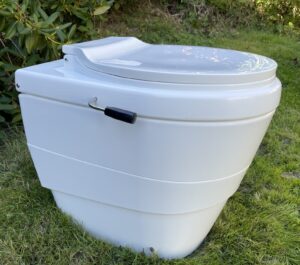
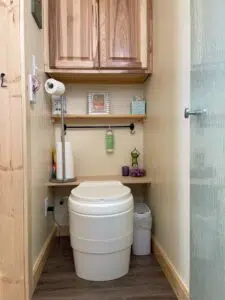


Composting Toilets for Tiny Homes

composting toilets for tiny home

Thinktank composting toilets for tiny home

There are many reasons to consider a composting toilet or waterless toilet for your tiny home. Sewer hook ups can be problematic. Holding tanks have to be dumped or pumped. Incinerating toilets are expensive, use a lot of energy, and the exhaust can smell awful.

A composting toilet is therefore an excellent solution in a tiny home.

tiny house composting toilet

tiny house composting toilet

Ventilation

There is not a lot of air inside a tiny home! You must be very conscious of any fan, appliance or toilet that exhausts air, especially if it is cold or hot outside and all windows are closed. I have seen many situations where a powerful bathroom fan or range hood fan over powered the small fan in a  composting toilet. The result was stinky air was pulled IN to the home from the toilet! Ugh.

There are a couple of solutions. The simplest (and in our view the best) option is to install a Thinktank Waterless Toilet, which is an ideal composting toilet for tiny homes. These airtight toilets draw ventilation air from outside the tiny home, circulate it inside the toilet, and exhaust that same air outside. It is a closed system, and you won’t be depleting the air in your tiny home. Plus, you will save on energy costs, as you will not be blowing expensively heated or cooled air outside, as you are with we think all other waterless and composting toilets on the market today.

If you already have a composting toilet for a tiny home, you’ll need to make sure the fan in the toilet is not over powered when you turn on another fan elsewhere in your tiny home. You can crack a window in the bathroom, and shut the door. Weatherstripping under the bathroom door helps a lot.

There are commercially available systems for “make up air”. These may be a bit expensive, and are possibly overkill for a tiny home.

Vent Location

Separett composting toilet power free installationIt is critically important to properly locate the vent for your tiny house composting toilet. There is not a lot of odor coming out of the vent pipe – but there is some. The end of the vent pipe should not be within 8 feet of any area with foot traffic, a door, or an opening window. Sometimes you can just go straight out the wall and that location is fine. If not, you need to go through the wall, put a 90 degree elbow on the pipe, and run it up to the roof or above. There are other options, including going through the floor. But remember that air does not like to travel through a pipe, and the pipe must be as short and straight as possible. Consult with the person who sold you the toilet, or an HVAC specialist if in doubt.

Urine Drains for Tiny Home Composting Toilets

The pee from you tiny home composting toilet must be disposed of. If you are semi-permanently located, you may wish to run the urine drain line into a French drain or gray water system. If you have to move around, you’ll need a tank situated below the height of the toilet drain. On the Thinktank this is 7 inches high, at the back. You can buy a plastic tank, or even use a plastic gas can. Remember you will have to either lift out this tank and dump it, or connect a simple pump.

Urine drains are critical. Composting toilets for tiny homes.

Urine drain (black pipe) exhaust vent and air intake on a tiny house composting toilet

The smaller, self contained composting toilets like the Airhead and Nature’s Head have urine bottles which are removed and dumped elsewhere. While initially easier to install, this is less convenient overall, because emptying the bottle gets tiresome. Two people will empty the bottle every 2 days or so.

Power for Tiny Home Composting Toilets

Proper, professionally designed composting toilets for tiny homes have fans. Don’t believe anyone that tells you otherwise. Vast experience has proven this to us. There is stinky, moist air in your toilet. It has to get outside. There are those that say you can bury the waste under sawdust. But this will drastically reduce the capacity of your tiny house composting toilet (and you do not want to empty more often that necessary!) Also, this requires a supply of sawdust in your home which takes up space, is messy, and may contain insects. Then, you hope it doesn’t stink. No. Get a toilet with a fan.

Composting toilets for tiny homes generally use very little power. Only a small fan is required. This usually only uses 2 or 3 watts of electricity. If you have a power hook up, just plug it in to a wall outlet. If you are off grid, power can be supplied by a 12 volt deep cycle battery. (Not a car battery. These are sometimes called marine or RV batteries).  The battery can be easily charged with a small solar panel.

Summary

Composting toilets for tiny homes can be an ideal solution for the tiny home owner or builder looking for a simple, cost effective solution. If you plan carefully and pay attention to the details, you should have an odor free and problem free system for managing human waste.


How Our $33,000 Tiny House Changed Our Lives

How Our $33,000 Tiny House Changed Our Lives – by Gabriella Morrison, author of Tiny House – Designing, Building, Living

The tiny house movement has taken the nation by storm and is rapidly spreading to other countries around the globe as well. The genesis of tiny houses, as most of us picture them, came from the creative vision of a man named Jay Shafer. In the late 1990s Jay grew tired of spending winters in his Airstream which was not insulated and adapted for a midwest climate. Sparked by ideas he’d seen in some home-built RV books, he took it upon himself to design and build his own diminutive home on a trailer base. It suited his needs and saved him a ton of money over conventional housing.

There’s no way that Jay, or anyone for that matter, could have predicted how much his tiny house was going to alter the very tapestry of housing in the US. Tiny houses are now bona fide, offering solutions to those in financial need, veterans, college students, environmentalists, minimalists, and more. Codes and zoning are changing at rapid speed to accommodate the swelling of interest. Outside industries are rushing to create solutions specific for tiny houses (insurance, lending, technology, construction materials, appliances, etc.). What was once a sparse desert is now a tropical and lush landscape teeming with life and opportunity.

tiny house kitchen

People from all walks of life become enchanted with tiny houses. Truly, with our website www.TinyHouseBuild.com as a DIY resource charged with empowering novices building their own tiny house lifestyle, we hear from people as young as 14 to as golden as 80. From homeless people who are excited to finally have the opportunity for safe shelter, to retirees who would rather save resources and live in something that isn’t wasteful. From soon to be college students who don’t want to follow in their previous generations’ footsteps towards debt, to young families who above everything else value time spent together and a lifestyle that promotes that possibility.

For my husband, Andrew, and I personally, we were driven to the tiny house movement after discovering that in finally achieving the infamous “American Dream” in 2009, we had paid the ultimate price: time away from our two kids, an increase in stress, and a radical deterioration of our happiness. Our new beautiful house had dismantled years of close connection as a family and a lifestyle focused on joy, health, and experiences rather than material possessions. Six months after move-in, we discovered the tiny house movement and within six months after that, we had gotten rid of the house, 90% of our worldly belongings, bought a pop up tent trailer, and moved to the tranquil beaches of Baja, Mexico to “reset”.

tiny house hallway

In our 150 sq ft pop up tent trailer, we realized that while living with the least, we were experiencing the most. Our inter-personal relationships improved to their best selves ever, and the inner tranquility we felt from a slow lifestyle was so intoxicating that we struggled to come back up to the States to rejoin our lives up here. In that moment, we committed to creating a lifestyle that would best give us the possibility of success and inner calm: we decided to build a tiny house.

About three years after living in Baja, we found a very inexpensive piece of acreage in beautiful southern Oregon, designed and built our tiny house, and lovingly named it “hOMe”. The cost to build it was $33,000 which included all of the appliances and furnishings. Nearly half the cost of just the DOWN PAYMENT of the average house in the US. Assuming we never move out of here, we will never, ever have another housing payment again. The amount of stress we’ve been able to alleviate through this truth has been significant.

Our family of four lives on five mountaineous acres in an off-grid set up. We generate our electricity from the sun 9-10 months out of the year and rely on a gas powered generator on sunless winter days. Our Separett toilet is a large part of what makes our off-grid lifestyle so successful. One never knows just how invaluable a well functioning toilet is until they don’t have one. We had tried two other composting toilets when we first moved into hOMe and they had been disasters. We have been using our Separett for over three years now and still love it. We put our waste in a three stage composting bin away from our house and allow decomposition to transform it all. No odors, easy maintenance, no crank levers, easy urine management, and a nice, sleek look.

Tiny House Toilet

We have been living here for over 3.5 years and we continue to love it. Both Andrew and I work from home full time and we’ve found this space to be extremely conducive to a focused work environment. We spend a lot of time cooking and so our full sized kitchen with full appliances accommodates our active family’s needs. Our kids are 20 and 17 years old and use hOMe as their main base. Being a close family, they are often in here hanging out, watching a movie, cooking in the kitchen, and using the bathroom facilities. It’s truly amazing how well we are all able to flow through our tiny house without bumping into each other. For sleeping, both of our kids have their own small cabins right next to our place. They have no plumbing but do have power. This has been a wonderful arrangement for our family.

Tiny house living isn’t for everyone but our observation is that it’s a perfect fit for those that value close relationships with those they live with, those that are motivated to live a life that is economical and light on the planet, and those that are willing to deal with discomfort during a transition period. Most of us will go through a significant and often uncomfortable transition when first making the move to tiny. It’s not easy at first (it wasn’t for us) because most of us aren’t used to living in such close proximity to others. I can tell you though that after our own experience, and also from hearing from hundreds that have made the move to tiny, that the initial stage is very short and on the other side is a lifestyle that is more rewarding, peaceful, and joyful than most of us could even imagine.